Grief Life
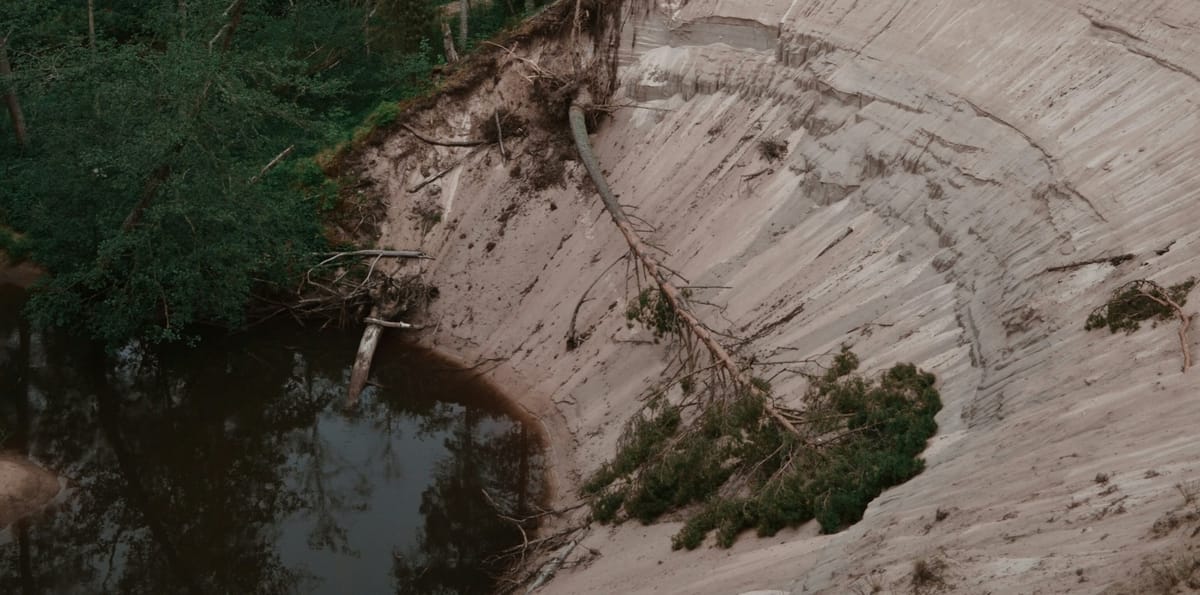
Diary Entry #1: I feel a tug in my gut as I write this, like the root bulb of a great tree pulling slowly, slowly over time from the ground as it tips from too much weight. The more it tips, the more the roots pull, and the more the space beneath is exposed.
I think the reason some of us are compelled to hold onto grief, to stay there in the moment, soaking in it, is because it’s the closest we will ever be again to the person we’ve lost. Whether that loss is a death or an estrangement, it’s potent nonetheless.
Sometimes I wish I was the sort of person who could chalk death up to "the circle of life" and estrangement to “necessary transitions,” then move on to the next thing and just keep charging ahead, but I can’t. It’s like I’m living two lives: the life that is mine, in the moment with my husband and pets and friends and community and projects, and the grief life—the one where I try to remember the last time I felt close to my sister, what my friendship with Michael was like—our special language—before he died, the way I felt the first time I saw Hannah: a dizzying electrocution.
I attended a writing workshop with Stephanie Adams-Santos recently. It was called, “In My Hand it Felt Like Singing,” and as I predicted, it wasn’t what I expected. In the best way.
Lots of time was spent in near silence. It was meditative. We were invited to dream. The point was to fully in oneself, in the moment, channeling. The writing portion lasted only a few minutes at the very end when we were asked to reflect on the most potent image, thought, or feeling we experienced.
I had seen myself on a cold beach, throwing the ashes of somebody not yet dead into the ocean. The phrase “a rehearsal for grief” comes to mind. I’ve borrowed that from a description of Autumn Knight’s performance art piece, Nothing#15: a bed—a performance which deeply moved me.
A few days after this exercise, I learned that my grandmother—my best friend and only lasting family relationship—has several aneurisms located all along the length of her aorta. Any one of them could burst at any moment, and there’s no way to know when. Make small movements, and avoid stress, and don’t lift very much weight are a few of the tips the doctors gave to help keep death at bay.
I begged to come for a visit, but she said I was being silly. That there was nothing to worry about. That her own mother had survived five heart attacks during her life—heart attacks which she never sought medical treatment for—and that she had used “mind over matter.”
My great-grandmother, Hedwig, lived until 96 or 97, and there was never any record of a heart attack, let alone five. I am positive that what she was actually experiencing were panic attacks. It sounds crazy unless you’ve experienced one so bad it feels the way you think a heart attack would, but I’ve experienced that once before and it really is shocking how sure you can be that your heart is going to explode, when really, that couldn’t be further from the truth.
I can’t push my grandmother on this, though, because to do so would cause her stress, force her to acknowledge how serious this condition is and how serious it is (to me) that she could be disappearing from my life at any moment. And stress is one of those things she must avoid.
But respecting her wishes means having our weekly phone calls like nothing is wrong, asking her to tell me stories about our family history like it’s not because I think each call could be my last chance to learn about myself.
I write down everything she says.
I feel a tug in my gut as I write this, like the root bulb of a great tree pulling slowly, slowly over time from the ground as it tips from too much weight. The more it tips, the more the roots pull, and the more the space beneath is exposed. That space where the roots used to be, fill in—with new dirt pushed in by weather than runoff and animals. I feel the pit growing a little larger every day as she tilts toward death, and I try furiously to keep it from filling in.
There is a pit in there for my sister, too. Each day I walk down to the shore to tend it, the waves have filled it in. Barely an impression anymore. I dig it back out and try again.
My sister’s not dead or dying, but she is no longer known to me. An “after,” and we no longer recognize each other. I cling to the memories I have of our relationship “before”—before our mother got to it. I remember couch cuddles and bumper boats and teaching her to read. I remember begging God for a little sister, holding her for the first time, and that time I thought she had a rapid aging disease that was going to kill her before she got old enough to really know me.
She didn’t have the disease. Still, she doesn’t really know me.
I woke up moaning and sobbing from a nightmare today. I won’t describe it here because it’s just too sad, but the final scene was of me, gripping the railing of a bar next to a waterpark. I had been running desperately up to every man I could find to tell them my sister was missing, to ask if they’d seen her, to beg them to help, but I could only whisper, and they all just laughed. Defeated, enraged, grief-stricken, a stumbled toward this railing—a railing along a walk way that connected to sides of the room and looked out over the floor of the bar (a sandy, dirt floor)—and fell to my knees without letting go, howling, moaning, calling out like I’d been gutted.
In the beginning of the dream, my sister was a baby and I was taking care of her. By the end of the dream, she was nine or so, the same age she was when I left home at eighteen. Because of how things were at home, I rarely returned.
In the dream, near the end, I watched her being kidnapped, but I didn’t know it was her and I didn’t know that what I was witnessing was a kidnapping. Her kidnappers had her in a wooden barrel, like the ones bar tables are made from at Outback Steakhouse, and when she stuck her head out as this group of people (a family) were wrangling her, there was a mask over her face—one that looked like the masks they wore in Infinity Pool. The family was behaving as if the incident was a jolly commotion, a strange game, and although something felt off, I didn’t know why or what I could (or should) do about it.
It wasn’t until I saw a clip of the commotion on the news report about my missing sister, that I realized I had watched her be taken away.
I had been in charge of protecting her throughout the dream, including that day, and I had failed.
I cried for a long time after waking, and I tried everything I could not to open my eyes. To do so would be to leave the place of the dream where I am still young and she is still young and we’re both still the people we were “before,” and return to the place of the bed, with my husband, with our pets, as a thirty-eight year old woman living on the other side of the country. To open my eyes would be to remember that I’m still in the “after."
In my grief life, my sister is right next to me, and I am complete. In my grief life, Michael is still alive and someone I can still get kicked out of movie theaters with for laughing too hard, who knows all my faults and failings and loves me still, who I can call and tell anything to. In my grief life, I didn’t slowly push Hannah away when my mother and boyfriend made fun of her, when other kids made fun of her, and I would have been there for her when she was at her lowest, planning how to die.
In my grief life, my father is still the man who playfully chased after my mother’s car while I watched from the back window, saying, “Don’t goooooo, don’t goooooooo,” loud enough that I could hear through the glass. He smiled and I laughed and it might be the only good memory I have of him.
In my grief life, I am small, three or four, living with my mom and my grandmother, and it’s late. Long past my bedtime. My mother leaves her friends on the porch to sit in my room, tickling my back and telling me the story of my birth—a story about fairies and toadstools and rain-slick blades of grass—to help me fall back asleep after another terrible nightmare.
I need my grief life. Because without it, I’ll lose my grandmother any day; Michael is dead and somebody I can never call again; Hannah died before I could tell her that I loved her and was sorry; and my sister is a stranger who lives far away.