Nancy Kerrigan: Tonya’s Takedown was Her Loss, Too
Fall Girls Entry #2: Two women get punished for a man’s violent actions

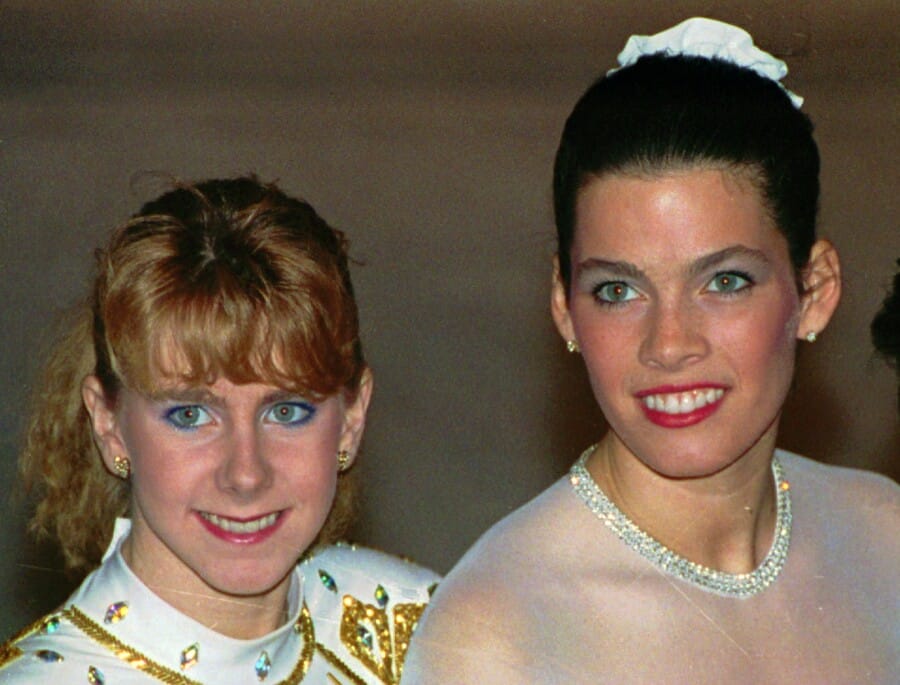
I was a “Tonya Girl” from the get. I still am. Regardless of where my loyalties lay, though, I never wanted anything bad to happen to Nancy. I mean, she’s a person. A person who didn’t deserve to be hurt and traumatized, and I was glad to see her recover and get back out there. I’m sure it was daunting to make herself vulnerable again by performing at the event the attackers were trying to prevent her from skating. I bet it crossed her mind that the attacker may have been working with other people. But even without that concern, I can’t imagine how either of them managed to charge ahead while hounded by paparazzi and scorned by former fans.
Yeah, that’s the part that stuck with me, too. Because Nancy wasn’t scorned, right? She was an American treasure, a real angel who could do no wrong. And the attack just made people love her more, right?
If that’s what you thought, then you are in good company, because that’s what I thought, too.
Despite all my research on Tonya, specifically, and “the incident,” generally—documentaries, countless essays, chapters of books published recently and books published in the nineties—I didn’t see anything about the attack hurting hurt Nancy’s reputation. I couldn’t imagine how it would have. After all, she hadn’t done anything to deserve the attack. How could anybody hate a person for suffering, especially when that suffering was caused by some random person’s decision to cause harm?
I don’t have the answer to that, but I supposed you could ask the countless numbers of women who have been marked as liabilities for reporting workplace harassment before unceremoniously being made “redundant." We love to blame a victim. Or I guess you could ask me: a pariah now in my graduate program because I was willing to speak out about inequity, ableism, and a lack of procedure around unethical behavior, equity complaints, and bullying.
“The oppressed cannot oppress the oppressor”—a quote by Simone de Beauvoir, my favorite problematic feminist, is oft-resurrected in the moralizing classrooms of my critical studies graduate program. It is invoked when talking about victim blaming, crimes committed by people economically depressed due to systematic inequity, black people retaliating against discriminating white people … the list is long. And yet, somehow, praxis seems nowhere to be found. Even my scholarly grad school critical studies and sensitive art school cohort seem to have lost the thread on humanity and compassion.
They love to blame a victim, too, and the administration would rather just not bother.
Point being, dealing with a victim is a chore. It’s a bore. And it reminds us that bad things happen in the world (sometimes at our own hands) and the last thing we want to do is self-reflect, consider someone else’s needs, or make time for compassion. We need somebody to hate, goddamnit! And boy did people hate Nancy. This whole time, I had no idea.

Perhaps because the tabloids I saw were dominated by Tonya headlines right up until she was replaced by the OJ scandal.
I’m reading 90’s Bitch by Allison Yarrow right now—a book that was recommended to me by whatever algorithm based on my purchases of books like Y2K: How the 2000s Became Everything by Colette Shade, Girl on Girl by Sophie Gilbert, and Men Who Hate Women by Laura Bates—and was thrilled when the chapter I turned to first (I often start by reading these cultural historical surveys out of order), “Catfight,” happened to be about THE INCIDENT!
Yarrow did something that I haven’t seen other scholars and critics do (don’t bash me if I’ve missed someone, just send me a link!): she made Nancy into a three-dimensional person rather than treating her like the blank canvas America had been so used to foisting their projections upon. She cited journalists and news outlets and “a self-described father of three sporty daughters” whose opinions of Nancy had all but entirely degraded simply because she deigned to be victimized, or deigned to respond differently to a bashing than these insulated commentators thought that she should.
The father of three “called her an ‘embarrassing sight’ and suggested she was ‘mentally soft’” (255) for being a “crybaby” following the incident. The fuck!? I mean, the girl was just clubbed!!!
A Denver Post article read, “‘We don’t want to look at Kerrigan and be reminded of how ugly the world can be” (256).
They went on to write, “‘When the attacker struck Kerrigan… The perpetrator “took a crowbar to porcelain legs…”raped a sports myth by beating Kerrigan.’” For a male-dominated news outlet to liken the loss of Kerrigan’s pre-incident virginal qualities to rape is not surprising. Disgusting, but not surprising in the least. Poor guys. How hard for them that must have been.
This same “news” paper wrote “The olympic princess became just another crime statistic."
Really!?!? That’s it? Give up your entire childhood training to be an OLYMPIC ATHLETE FOR GODSAKES and one wrong move (ie, existing as a woman in a misogynist world), and you’re bye-bye bananas.
On 257, Yarrow writes, “Kerrigan’s delicate image and her sport’s decorum stood in sharp contrast to the violence she’d suffered, hence the eagerness with which followers of the story gawked at and bitchified her."
I think the quote that stood out to me the most, the one that reverberated was this one from the Denver Post: “We don’t want to look at Kerrigan and be reminded of how ugly the world can be."
Wow. I wish I could call on Freud to discuss the collective underdeveloped ego of American male journalists (and, apparently, fathers of three). They’re the real crybabies.
What is it that makes men* so damn territorial over the ideals represented by women they’ve never met? It’s honestly just really weird.
*
Like most of the posts here, I’m not really trying to prove anything necessarily. There’s no conclusion. The research is ongoing. Just sharing reflections as I progress!
*I know, I know, some men. But listen. I’m married to a cis man whom I love—he’s the love of my life—and that doesn’t change the fact that too many other men have assaulted and harassed me (and no, I don’t wear short dresses, not that that should matter) for me to not be suspicious of and on guard around every other man who is a stranger to me. My life, unfortunately, depends on it. My reputation? Not so much? People already hate me. What a relief!